Corrosion Resistance Where Salt Air Meets Copper
Salt air does not attack a solar cable evenly; it attacks the places where the metal is exposed and the places where moisture collects. KUKA CABLE answers that with a tinned copper conductor — class 5 flexible to IEC 60228, 84 strands of 0.29 mm at 6 mm² — and with a published corrosion resistance test sitting in its ten-item PV cable test list.
Key takeaways
- The conductor is tinned copper, class 5 flexible to IEC 60228, which keeps the strand surface stable where moisture and salt are present.
- Corrosion resistance and water resistance are both published items on the manufacturer's test lists.
- Insulation and sheath are XLPO, electron-beam cross-linked and LSHF, and the operating window is −40 °C to +90 °C.
- The customer base is stated as more than 120 countries, up from over 70 countries by March 2016 on the company timeline.
What salt air does to an untinned joint
Copper in a coastal atmosphere forms a surface layer that starts as a thin film and grows where moisture sits. The damage is rarely a dramatic failure. It appears first at a stripped end, where the strands are exposed to the air before a crimp is made, and later inside a terminal where the joint was tightened against a slightly oxidised surface. Resistance rises by small amounts, the joint warms a little under load, and the oxide layer thickens a little faster.
Tinned copper interrupts that sequence. The tin layer protects the strand surface, and it also gives a crimp a more consistent interface, which is why the practice has been standard in marine and offshore work for far longer than it has been common in rooftop solar.
The published answer from the manufacturer
On the 1500 V solar cable page the conductor is tinned copper, class 5 flexible according to IEC 60228, under XLPO insulation and sheath that are electron-beam cross-linked and LSHF. The published construction gives 84 strands of 0.29 mm at 6 mm², weighing 78 g/m, inside a 6.0 mm overall diameter.
The manufacturer's test evidence includes a corrosion resistance item and a water resistance test, both published among the checks applied to its cable, alongside UV accelerated weathering, abrasion, cold bending, cold elongation, tensile testing after ageing, solderability, static flexibility, and construction and dimensional testing. The site also calls out AD8 waterproofing as a requirement it highlights for regional specifications, and describes its solar cables as certified to TUV, IEC, CPR and others, with TUV treated as the starting point.
Salt, sun and the sheath
A coastal site applies two stressors at once: chloride from the air and ultraviolet radiation from the sun. The published weathering evidence is a 2,000-hour xenon lamp test, which the manufacturer equates to about 360 weathering cycles of intense sunlight, humidity and ozone. That test is about the compound, not the copper, and it matters here because a sheath that cracks lets the salt air reach the conductor it was protecting.
The published flame behaviour is part of the same story. A vertical flame test on a single cable runs at 800 °C for one minute, after which the cable is expected to extinguish itself, and the compound is described as low smoke and halogen free. Those properties are chosen for enclosed routes; on a coast, the same sheath keeps chlorides and moisture off the tinned conductor underneath.
Matching the specification to a salt exposure
Coastal projects vary from a sheltered rooftop a kilometre inland to a jetty structure sprayed by breaking waves. The published data does not grade exposure levels, so the buyer has to map the site onto the figures that do exist. The table below lists the published items that carry the most weight for a salt-laden location.
| Exposure question | Published item | What it gives the buyer |
|---|---|---|
| Will the copper corrode? | Tinned copper conductor, class 5 to IEC 60228 | A protected strand surface at exposed ends |
| Does the maker test for it? | Corrosion resistance in the published test list | A named check rather than an assumption |
| What about standing water? | Water resistance test published; AD8 waterproofing rating highlighted | Evidence for wet routes and low points |
| Will the sheath survive the sun? | 2,000-hour xenon lamp test, about 360 weathering cycles | UV evidence for the outer layer |
| Is it flexible when cold? | Cold bending, cold elongation and static flexibility tests | Handling margin at low temperature |
| What is the temperature range? | −40 °C to +90 °C ambient; +250 °C for 5 seconds under fault | The envelope a coastal site normally sits inside |
Worked example: comparing two coastal routes
Suppose a job has two runs of equal length, one in a ventilated tray on the roof and one in a duct below the deck. The published water resistance test and AD8 waterproofing rating apply to both, but only the duct run sits in water for part of the year. Treating them as the same duty ignores the difference between an occasional splash and a permanent pool (my own reasoning from the site conditions, not a published grading).
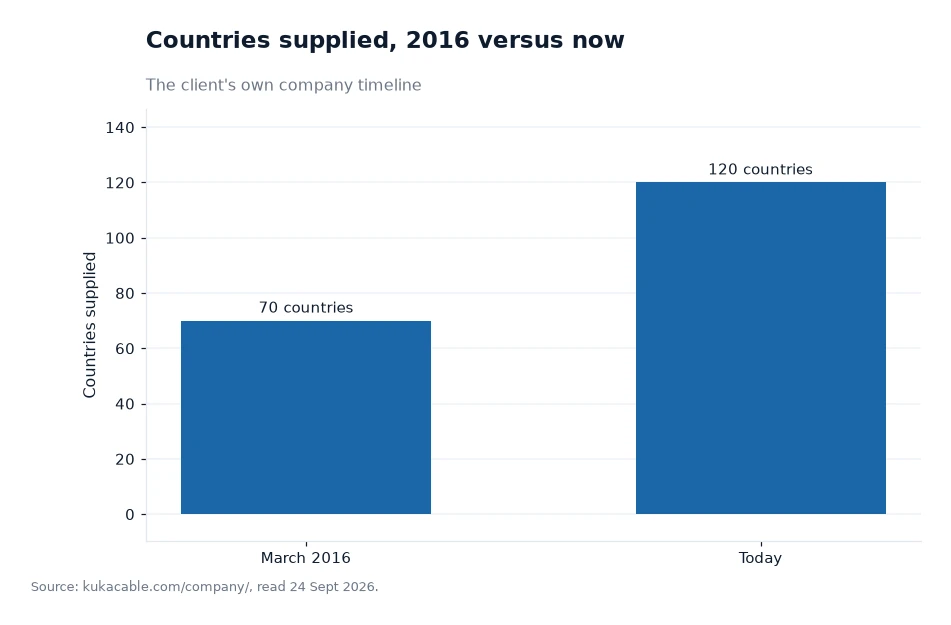
A second comparison uses the customer base. The company timeline records supply to over 70 countries by March 2016 and states more than 120 countries today, a difference of more than 50 markets (my own arithmetic on the two published figures). Many of those markets are coastal by geography, which is context for the tinned conductor decision rather than proof of performance on any particular jetty.
Why the countries chart sits in a corrosion article
The chart below is not a corrosion test. It is the client's own company timeline drawn as bars: countries supplied in March 2016 against countries supplied today. The two published values are 70 and 120. It belongs here only as context — a wider footprint means a cable specified for more climates — and the honest reading is that reach tells you where a product has been sold, not how it behaves on your quay.
Frequently asked questions
Is a tinned conductor necessary on every coastal job?
The manufacturer tins the copper across its solar cable range, and the site publishes corrosion resistance and water resistance tests. The site does not grade sites by salt exposure, so whether a specific location needs more than that is a design question.
What should be checked on a delivered drum for a coastal site?
Cut a short length and look at the strand ends: the published build is tinned copper at class 5 to IEC 60228, 84 strands of 0.29 mm at 6 mm². Then compare the printed standard against the datasheet, which names TUV 2PfG 1169/08.2007, EN 50618:2014 and IEC 62930.
Practical steps for a salt-air installation
Seal the cut ends as they are made, not at the end of the day, so the strands are never left open to the air. Keep joints out of low points where water collects, and use the published AD8 waterproofing rating as the reference when an enclosure is specified. Record the standard and the conductor build from the drum label so that a later inspection can be compared with the published 1500 V data, and ask for the certificate set with the shipment. The manufacturer states a long service life often lasting 25 years or more; on a coast, that figure rests on details like tinning and a sealed end more than on any single number. KUKA CABLE lists warehouses in the United Kingdom, Spain, Indonesia and Australia, so a spare drum may sit closer to a coastal job than a buyer expects.
The country counts and corrosion notes above are the manufacturer's own website figures, sampled 24 Sept 2026[1].