A Middle East launch adds three variables to an ordinary fragrance scale-up: heat exposure, shipping distance, and a labelling and registration path that may not be ready when production is. Each one changes what a brand should settle before bulk begins. The checklist below follows the order of a real project - specification, stability, packaging, labelling, shipping, inspection - and highlights the places where a Gulf-bound order differs from a domestic or European one. It is written for established beauty brands adding a regional launch, not for a first-ever fragrance order.
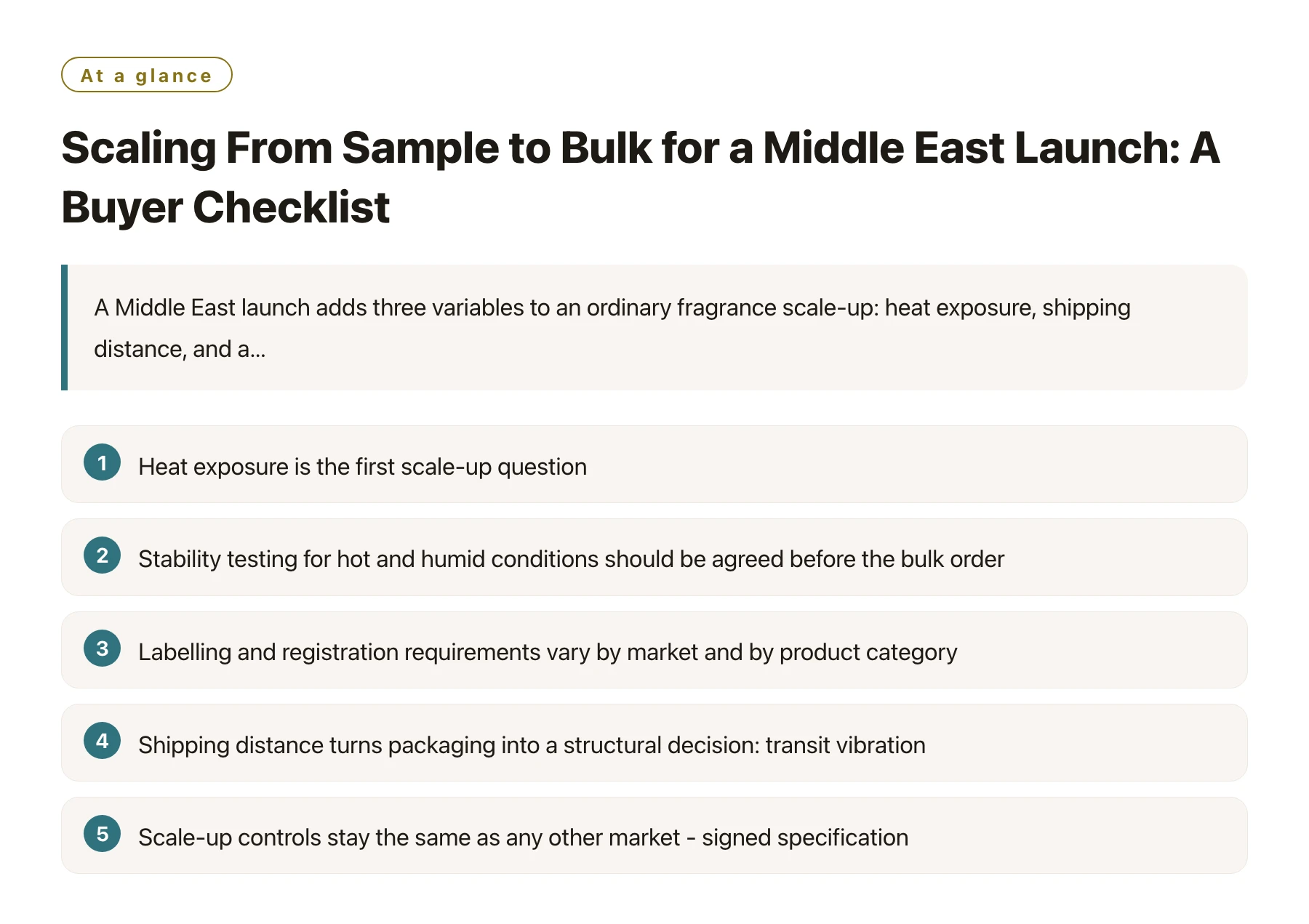
Key takeawaysHeat exposure is the first scale-up question, not a packaging afterthought: a formula and pack that behave well at 20 degrees may separate, discolour or lose top notes after weeks in a hot warehouse. [1] · Stability testing for hot and humid conditions should be agreed before the bulk order, with the pack and the juice tested together rather than separately. · Labelling and registration requirements vary by market and by product category, and the registration clock often runs longer than production, so both should start at the same time. · Shipping distance turns packaging into a structural decision: transit vibration, pallet configuration and secondary packaging determine how many units arrive saleable. · Scale-up controls stay the same as any other market - signed specification, named owner, acceptance protocol - but the hot-climate and transit checks are added to the acceptance criteria. [2] · The brands that struggle are the ones that treated the Middle East as a destination rather than as a set of conditions the product has to survive.
Regional launches fail for unromantic reasons. The scent sells, the price is right, and then a pallet sits on a quay in August and the juice darkens. Middle East launches concentrate several of these risks because the transit is long, the ambient temperature is high for much of the year, and the regulatory path differs from the one most European brands know.
This checklist assumes the sample is approved and the launch is real. It covers what has to be re-verified before the bulk order is released, and what should be written into the acceptance protocol rather than left to luck.
Start with the conditions, not the calendar
The useful first question is where the product will physically be at each stage: in a factory, in a container, in a customs area, in a distributor warehouse, in a retail back room. Each of those environments has a temperature and a duration, and the longest or hottest one sets the stability requirement.
That framing changes the brief. Instead of asking for a general stability test, the brand can specify the exposure - so many weeks at an elevated temperature with a defined pack - and ask whether the formula and packaging combination meets it. [1]
It also changes the schedule. If stability work has to run for weeks before the bulk order, the launch date has to absorb it, and that is cheaper to plan now than to discover a reformulation request after tooling.
Middle East scale-up checklist, in project order
| Stage | What a Gulf-bound order adds | Who should own it |
|---|---|---|
| Specification | Pack and juice specified together for hot conditions | Brand product lead with factory technical contact |
| Stability | Elevated-temperature and humidity exposure agreed with a duration | Factory laboratory, reported to the brand in writing |
| Labelling | Market-specific requirements confirmed for the category | Brand regulatory contact with the factory's compliance lead [3] |
| Registration | Timeline mapped before production starts, not after | Brand regulatory contact, with factory documents supplied |
| Packaging | Transit-suitable primary and secondary packaging, pallet plan | Brand packaging lead with the factory's filling team |
| Scale-up | Acceptance protocol extended with heat and transit checks | Named factory owner, countersigned by the brand |
| Inspection | Pre-shipment check that includes pack integrity after transit simulation | Third-party inspector or the brand's own quality lead |
| Logistics | Thermal exposure of the route understood before booking | Brand logistics contact with the forwarder |
The additions are modest in cost and large in effect. Most of them are questions rather than equipment, which is why they belong in the brief rather than in a change order later.
The scale-up sequence, with the launch-specific checks folded in
- Freeze the specificationDosage, base, pack and reference standard on one signed page, with the hot-climate exposure requirement stated as part of the specification.
- Run stability on the finished packJuice in the actual bottle with the actual closure; a formula test in glass says little about what a heavy decorated bottle does in the heat.
- Confirm labelling and registration in parallelKeep the regulatory clock running beside production, and collect the factory documents the registration file needs while the batch is still in planning. [2]
- Extend the acceptance protocolAdd pack integrity, leakage and appearance checks to the criteria used to compare bulk against the approved sample.
- Verify before shipmentInspect the finished pallet against the limit sample and the packaging specification, and record the conditions at inspection.
- Plan the routeAsk what temperatures the container will see, and whether a controlled route is justified for the first launch shipment.
Write the acceptance protocol before the bulk order is placed, not when the pallet is ready. A protocol that includes the markets where the product will be sold, the labelling schedule and the inspection point is the document that keeps a launch on track. If the manufacturer's own published scope makes those checks explicit - which is what a factory that handles fragrance R&D and production usually does when it serves several export regions - you can compare its answers against a concrete list instead of a promise.
Three mistakes that cost a season
The first is testing stability on the juice alone. A fragrance that survives heat in a laboratory bottle can still discolor against a metallised closure or deform a liner, and the pack is where most launch defects appear.
The second is treating registration as a post-production task. Documents that a registration file needs are easier to obtain while the batch is being planned than after the shipment has left, when requests travel through three parties.
The third is accepting the first pallet configuration proposed. Transit distance rewards a slightly overbuilt pack - better secondary packaging, tighter pallet wrap, fewer units per layer - and that decision has to be made before the boxes are printed.
Getting scale-up right for one region is also how a manufacturer becomes useful for the next. A factory that documents its own route from compounding to filling is easier to audit for a new market because there are fewer handovers to inspect, and the scope it publishes on the Xuelei website is the version you can check against your own list before the second launch rather than after it.
Where several steps sit under one roof, a second regional launch can often reuse the stability and packaging work from the first, with the labelling and registration changes layered on top. That reuse is where full ODM fragrance service arrangements earn their keep, because the development record already documents the parts of the product that do not change by market.
Sources
- Cosmetics Europe —— The European trade association for the cosmetics and personal care industry, publishing guidance, positions and market information.
- IFRA: Safe Use and Fragrance Science —— IFRA's explanation of how fragrance materials are scientifically assessed for safe use and how those conclusions are applied by the industry.
- European Commission: Cosmetic Products — Specific Topics —— EU pages covering specific cosmetics topics such as product claims, nanomaterials and animal-testing rules.
Frequently asked questions
What is different about scaling a fragrance for a Middle East launch?
Three things: heat exposure, transit distance, and a labelling and registration path that differs from the EU or US. Stability work should be run on the finished pack under conditions that resemble the route, packaging should be specified for long transit, and registration documents should be collected while production is being planned.
How long should stability testing run before a hot-climate bulk order?
It should cover the exposure the product will actually see, which often means several weeks at elevated temperature plus a humidity element for the pack. Agree the duration and the conditions in the specification, and treat the result as a gate before the bulk order is released.
Does a Middle East launch require halal certification?
It depends on the market and the product category, and requirements are administered locally rather than uniformly across the region. Ask the manufacturer which documentation it can supply for the specific market you are entering, and confirm the current requirement with your importer or regulatory adviser before ordering.
Which packaging decisions matter most for long-distance shipping?
Secondary packaging strength, pallet configuration, closure and liner integrity, and the total weight per layer. These determine whether units arrive saleable, and they are cheapest to change before the artwork and the boxes are printed.
When should the pre-shipment inspection happen?
After the finished pallet is built and before the container is loaded, against a signed limit sample and the packaging specification. Recording the temperature and conditions at inspection is also useful, because it gives the brand a baseline if a defect is discovered after arrival.