Teaching an AI Companion Your Preferences
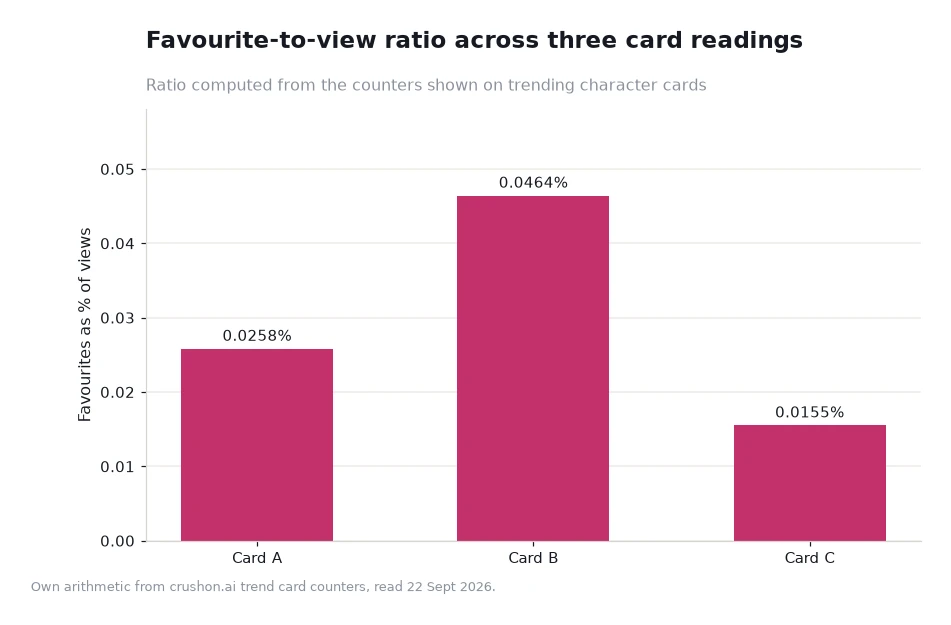
Preference shaping is not a setting you switch on; it is a loop you close. Every message either confirms a direction or contradicts one, and the effect accumulates across sessions rather than inside them. The clearest evidence that depth beats volume comes from the trend cards, where the strongest reading in a set holds about 0.046% of its views as favourites and the weakest about 0.016% — a near threefold gap in how well listings keep the people who open them.

Key takeaways
- Three loops do the work: what you instruct directly, what you choose again, and what you finish rather than abandon.
- Shaping is cumulative. Six sessions at 15 minutes each is 90 minutes; spread over three weeks it gives the pattern three chances to settle.
- Contradictions cost more than omissions. A preference stated once and then ignored twice teaches the opposite of what was written.
- Ratios on trend cards are the macro version of the same effect, ranging from roughly 0.016% to 0.046% favourites per view.
The three loops
The first loop is explicit. Writing a preference into a prompt — measured rather than blunt, curious rather than deferential — is the fastest way to change a reply, and the easiest to overdo. An instruction repeated every message is noise; an instruction stated once and then honoured by your own tone is a pattern.
The second loop is selective. Opening one listing again and leaving another alone is a choice, and choices repeated over a fortnight amount to a preference even when nothing is ever written down. This is the loop most people run without noticing, and it is why the shortlist that follows you around tends to look narrower each week.
The third loop is retention. Finishing a thread, returning to it, or favouriting a card are all signals of a different kind from instruction: they describe fit rather than intent. The platform's own phrasing about replies that adapt and characters that recall earlier interactions describes the mechanism these signals feed.
Shaping over weeks rather than messages
Preferences settle on a timescale of sessions, not turns. In the first session almost anything you write will be reflected back, because there is no history to weigh against it. By the fourth or fifth session a consistent direction has weight, and an inconsistent one has a track record of inconsistency to match.
That makes the useful unit of effort a week, not a message. Two or three sessions of moderate length, each reinforcing the same register, move the thread further than a single long session in which the register shifts three times. Patience here is not a virtue; it is the mechanism.
There is also a version of shaping that works against you. If two threads are fed different registers in the same week, both give weaker results than either would alone, because each is being reinforced with statements the other contradicts. Illustratively, three sessions a week split across three listings is one session per listing; three sessions a week on one listing is a pattern. The arithmetic is trivial and the difference is not.
One more consideration applies to anyone who shares a device. Preference memory attaches to the conversations you actually keep rather than to the evening you spent, so a thread never opened again contributes nothing while one returned to twice a week does most of the work. Crushon describes this as characters that recall previous interactions and adapt over time, and the practical consequence is that whatever you return to is what gets shaped, whether or not that was the plan.
A final check is worth running at the end of any shaping cycle: read your own messages from three weeks ago and ask whether the register you meant to teach is visible in them. Threads follow the most consistent input, and the most consistent input is usually the one you are not thinking about.
| Loop | What it feeds | Sign it has stalled |
|---|---|---|
| Explicit instruction | Register, pacing and vocabulary | You are rewriting the same sentence every session |
| Selective return | Which listings stay in your shortlist | Your shortlist grows but nothing holds |
| Retention and favourites | Durability of a listing over weeks | A card you like keeps losing its place in the rankings |
| Consistency | Whether the pattern survives a gap | Replies feel new again after four days away |
Worked example
Two sets of arithmetic make the loop concrete. The first is on real counters. A card holding 0.0258% of its views as favourites keeps 2.58 favourites per 10,000 views. A stronger card at 0.0464% keeps 4.64. A weaker one at 0.0155% keeps 1.55. The strongest is therefore about three times the weakest, which is the same factor that separates a thread you keep returning to from one you open once.
The second set is an illustration, not platform data. Assume six sessions at 15 minutes each: 6 × 15 = 90 minutes, or an hour and a half of total chat time. Spread across three weeks, that is two sessions and 30 minutes a week. The same 90 minutes spent in one sitting would leave a single data point; spread out, it leaves six.
Add the arithmetic of repetition and the point sharpens further. Six sessions at two explicit instructions each is twelve reinforced statements, not one statement repeated twelve times — which is roughly the difference between a request and a habit.
Where the loop pays off most
The biggest gains come from narrowing before you instruct. Choose listings whose description already matches your register, then use the loops to refine rather than to convert. A thread that starts at six out of ten reaches eight quickly; one that starts at two rarely gets past five, however patient you are.
It also helps to know what the platform claims about its own behaviour. On its Porn Chat AI page it describes three properties: customisable characters with distinct personalities and interaction styles, a private and secure environment, and realistic advanced responses that adapt, recall earlier interactions and change over time. The third of those is the one a preference loop is built on, and it is worth reading on the ai porn chat page before you start writing instructions that assume something different.
Then keep a record. Three lines per listing — the register you wanted, the instruction you used, and whether it held after a break — turn guesswork into something you can repeat. The character search view is the natural place to rebuild a shortlist once you know which register you are actually reinforcing.
Frequently asked questions
How long does shaping take to show?
Expect a visible difference within three or four sessions if the instruction is consistent, and expect it to fade after a long gap if it was only ever stated once.
Should I restate my preferences in every message?
No. State them clearly, then reinforce them by matching your own tone. Repetition adds noise; consistency adds weight.
What do favourite-to-view ratios tell me?
They measure durability. A card keeping 4.64 favourites per 10,000 views is holding attention about three times better than one keeping 1.55.
Close the loop deliberately
Pick one listing, write two instructions, and stay with the same register for three weeks. Measure the result by whether you returned, not by how good any single reply felt.
That habit replaces endless switching with slow improvement, and it is the cheapest upgrade available on any adult AI chat service. Written for adults 18+.
Data and sources: card counters and platform wording read on 22 Sept 2026[1], including the adaptive-response description on the Porn Chat AI page. Favourite ratios are arithmetic on published counters; session and minute totals are illustrative assumptions. For adults aged 18 or over.