A supplier network review should identify the contracting company, production sites, material sources, subcontractors, and handoffs that affect an order. Buyers can assess capability, traceability, capacity, resilience, and ongoing performance when each relationship is tied to clear evidence and an accountable owner.
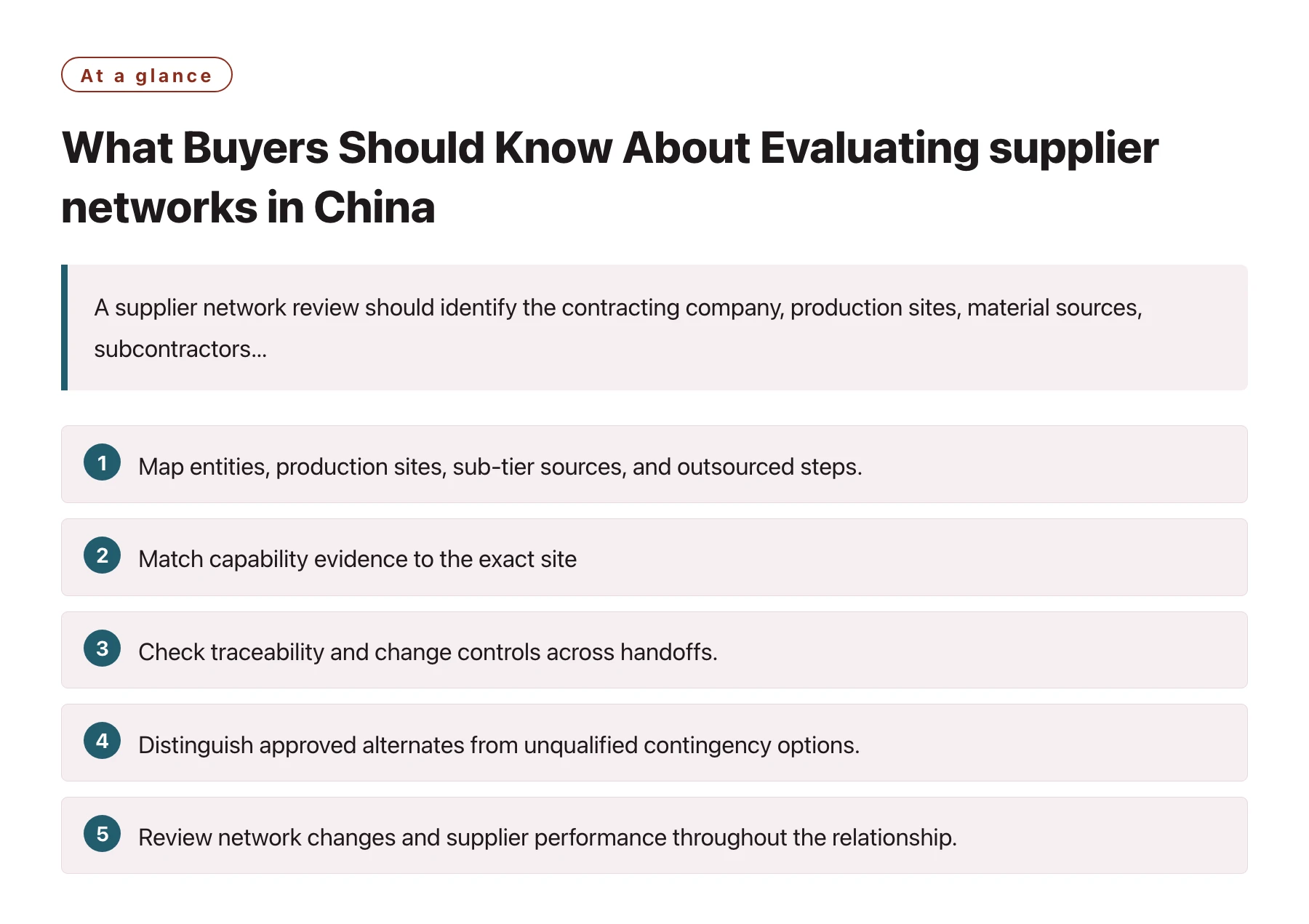
Key takeawaysMap entities, production sites, sub-tier sources, and outsourced steps. · Match capability evidence to the exact site, product, and order window. · Check traceability and change controls across handoffs. · Distinguish approved alternates from unqualified contingency options. · Review network changes and supplier performance throughout the relationship.
A quotation names a seller, but production may involve a wider network. Understanding those links helps buyers identify where information or accountability could be lost.
Map the network behind the quotation
A supplier network includes more than the company named on a quote. Map the contracting entity, actual production site, material sources, subcontractors, finishing operations, laboratories, warehouses, and logistics handoffs that affect the order. Ask which activities are performed at each location and which party is accountable for changes or defects.
Request an organization and process map tied to the product family. Record site names and addresses, capability, process ownership, and any subcontracted steps. Verify key relationships using documents and a site review appropriate to the project. A brochure or sales presentation can describe capability, but should not be treated as independent evidence that every facility performs the stated work.
Identify whether the proposed supplier is a manufacturer, trading company, export entity, or a combination. Clarify who signs the purchase contract, issues invoices, holds product records, and receives payments. Make sure the legal entity and production location are not silently substituted after approval.
Evaluate capability against your order profile
Compare each network member with the requirements it must meet: product type, process, equipment, capacity window, quality controls, traceability, packaging, and destination documentation. Ask for recent examples or records tied to similar work, and determine whether the evidence applies to the proposed site and current configuration.
Capacity is time-specific. Ask what is already scheduled during your requested production window, which resources are shared, what would be outsourced, and how a peak in demand affects lead time. Request a realistic milestone plan rather than an annual capacity claim. For a critical operation, identify the contingency if equipment, materials, or skilled staff become unavailable.
Supplier management covers the working relationship before and after contract award; CIPS guidance treats management of suppliers as an ongoing procurement capability.[1] Build review points for communication, delivery, nonconformance, change control, and corrective action instead of relying only on onboarding checks.
Check quality controls across handoffs
Follow a representative order or lot across network steps. Determine how material identity, product revision, inspection status, and nonconforming items travel with the work. Ask how a receiving process confirms incoming materials and how the finished product can be linked to its source lots and production records.
Define what must be approved before a subcontractor performs a special process. The primary supplier should identify process owner, criteria, records, change notification, and responsibility for corrective action. If a step affects safety, compliance, or a key product characteristic, have a qualified technical owner decide what evidence is sufficient.
Use a risk-based site visit or independent audit when the consequence of a hidden handoff is high. Distinguish system review from product inspection and define the evidence, sampling, and limits for each. A network review at one point in time cannot guarantee future continuity or the conformity of every shipment.
Measure resilience and alternatives
Identify single points of failure: one material source, one tool, one finishing facility, one export channel, or one individual who approves production changes. Ask how long it would take to qualify an alternate and what technical differences the buyer would need to assess. Do not list an alternate as approved until the relevant evidence and samples have been reviewed.
Consider geographic and operational dependencies without assuming that multiple company names create true redundancy. Two suppliers may share the same factory, sub-tier source, or freight bottleneck. Map these overlaps and decide which risks matter for the product and delivery schedule.
Agree on triggers for a contingency plan, such as repeated late milestones, a process move, a raw material change, failed inspection, or loss of a key subcontractor. Define who notifies the buyer, how options are compared, and whether production pauses while an alternate is approved.
Create a practical network scorecard
Use a small set of evidence-based measures: site and entity clarity, process capability, traceability, approved subcontractors, on-time milestones, quality escapes, corrective-action closure, document accuracy, and responsiveness. Mark data coverage and period so a score is not mistaken for a guarantee. Keep severe unresolved issues visible even if other metrics are strong.
For Shanghai JS Sourcing, buyers can ask for supplier network mapping and coordination as part of a clearly defined sourcing scope. Specify which entities and production sites will be checked, what evidence is returned, which checks are independent, how conflicts are disclosed, and who approves supplier status.
Review the network when a product, site, material, process, or order volume changes. Record the new configuration and decide whether qualification, sample approval, or inspection planning must be repeated. Keep a dated network map with purchase and quality records so teams can see which arrangement supported each order.
Sources
Frequently asked questions
Does a trading company automatically make a supplier unsuitable?
No. The buyer should understand its role, verify the production arrangement, identify who owns each control, and assess whether the documentation and accountability meet project needs.
How can a buyer confirm a subcontracted process is controlled?
Identify the process owner, approved site, criteria, records, change notification, and corrective-action responsibility, then review evidence appropriate to the process risk.
Are two supplier names a reliable backup plan?
Not necessarily. They may share a factory, materials source, or logistics bottleneck. Map dependencies and qualify an alternate before relying on it.
When should a supplier network map be updated?
Update it when the entity, site, material, process, subcontractor, or order profile changes, and decide whether qualification or inspection needs to be repeated.