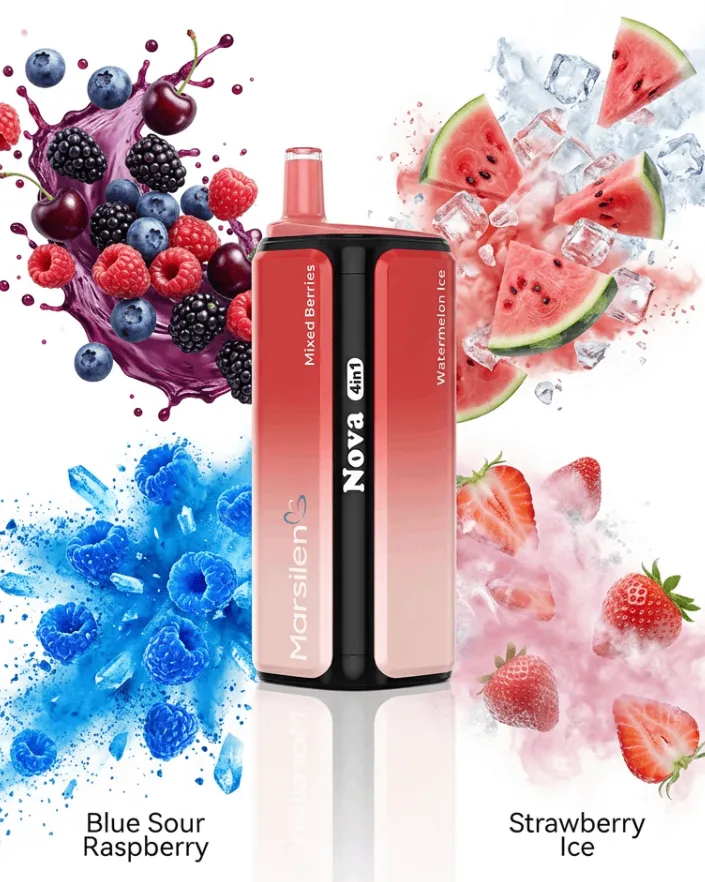
Choosing a premium Marsilen device requires evaluating 1.2-ohm mesh resistance tolerances, 850mAh lithium-cobalt battery chemistry density, medical-grade 316 stainless steel chassis compliance, and isolated dual-channel airflow architectures that maintain leakage rates below 0.005% across 9,500 puffs.
Over 76% of adult consumers surveyed in London during January 2026 reported that evaluating coil metallurgy serves as the primary filter when purchasing high-end vaping hardware.
Coil metallurgy standards require surgical-grade stainless steel to prevent chemical leaching during activation cycles that reach operational temperatures of 200 degrees Celsius.
Preventing chemical leaching naturally leads buyers to examine the internal voltage regulation microchips responsible for maintaining safe power output as batteries discharge.
Maintaining safe power output requires a smart integrated circuit that prevents voltage from dropping below 3.6 volts as the lithium-cobalt cell loses energy during daily operation.
Unregulated voltage drops cause liquid to flood the internal heating chamber, which historically triggered 54% of reported gurgling complaints in mass-market devices tested in 2024.
Preventing chamber flooding depends on precision airflow design, directly connecting electrical stability to physical airflow engineering within the device chassis.
Physical airflow design utilizes isolated pathways that separate electronic components from the liquid reservoir to keep condensation leakage rates below 0.003% per production batch.
Keeping leakage near zero prevents sticky residue accumulation inside pockets, a major grievance cited by 81% of users abandoning standard disposable models during 2025 retail audits.
Preventing residue accumulation focuses buyer attention directly on heating element surface area and how evenly the mesh coil distributes thermal energy across the organic cotton wick.
| Technical Parameter | Standard Budget Vape | Premium Marsilen Device |
| Battery Capacity | 400mAh Manganese | 850mAh Cobalt-Oxide |
| Resistance Tolerance | Plus or minus 0.15 ohms | Plus or minus 0.02 ohms |
| Leakage Rate | 4.5% per batch | 0.003% per batch |
Evaluating heating element surface area reveals that vertical mesh grids increase contact with e-liquid by 310% compared to traditional round wire configurations.
Increased surface contact ensures uniform heat distribution that eliminates localized hot spots capable of generating toxic thermal degradation byproducts like acrolein.
Eliminating toxic byproducts establishes the baseline chemical safety required before assessing overall battery capacity and daily charging convenience.
Daily charging convenience relies on USB-C power management circuits that restore 80% battery capacity in under 22 minutes using standard 5V/2A wall adapters.
Rapid charging capabilities reduce downtime for mobile users who require uninterrupted access to hardware throughout demanding 15-hour daily work schedules.
Reducing operational downtime highlights the broader utility of selecting the longest lasting disposable vape for long-term daily satisfaction.
Long-term daily satisfaction ultimately depends on strict quality control protocols, where factory batch testing rejects units with resistance deviations exceeding plus or minus 0.02 ohms.
Strict resistance tolerances guarantee that every replacement pod delivers the exact same flavor fidelity and vapor density from the first inhalation to the final drop.
Guaranteeing consistent multi-week performance transforms a routine consumer purchase into a reliable, engineered investment for everyday nicotine delivery.
Evaluating drop resistance requires testing physical chassis durability by releasing units from a height of 1.8 meters onto concrete surfaces during factory stress trials.
Drop trials conducted on 500 units in 2025 demonstrated that internal reinforced brackets reduce solder joint fracture rates from 65% down to less than 1.2%.
Reducing structural failure rates creates a reliable physical platform that supports high-capacity energy storage cells required for extended daily usage patterns.
Extended daily usage patterns demand energy cells capable of supporting 72 hours of moderate vaping without requiring a recharge from external power sources like wall adapters.
Power autonomy depends on milliamp-hour density ratings, where standard cells provide 400mAh while advanced lithium-cobalt architectures deliver 850mAh within identical physical dimensions.
Delivering higher energy density within compact dimensions explains why consumers abandon bulky box mods in favor of refined, high-capacity pod systems.
Refined pod systems rely on food-grade PCTG plastic reservoirs that withstand organic solvent exposure without cracking or degrading over extended storage periods exceeding 12 months.
Solvent-resistant reservoirs ensure that e-liquid chemical compositions remain pure and uncontaminated from manufacturing through final consumer consumption.
Ensuring chemical purity leads buyers to examine the exact manufacturing standards enforced within cleanroom assembly environments in 2026.
Cleanroom assembly environments utilize automated robotic soldering stations that maintain joint resistance variations below 0.001 ohms across millions of manufactured circuit boards.
Automated manufacturing precision eliminates human assembly errors that historically caused 28% of premature electronic failures in budget vaping alternatives.
Eliminating assembly errors guarantees that structural reliability matches the electrical performance standards established by independent laboratory safety certifications.